

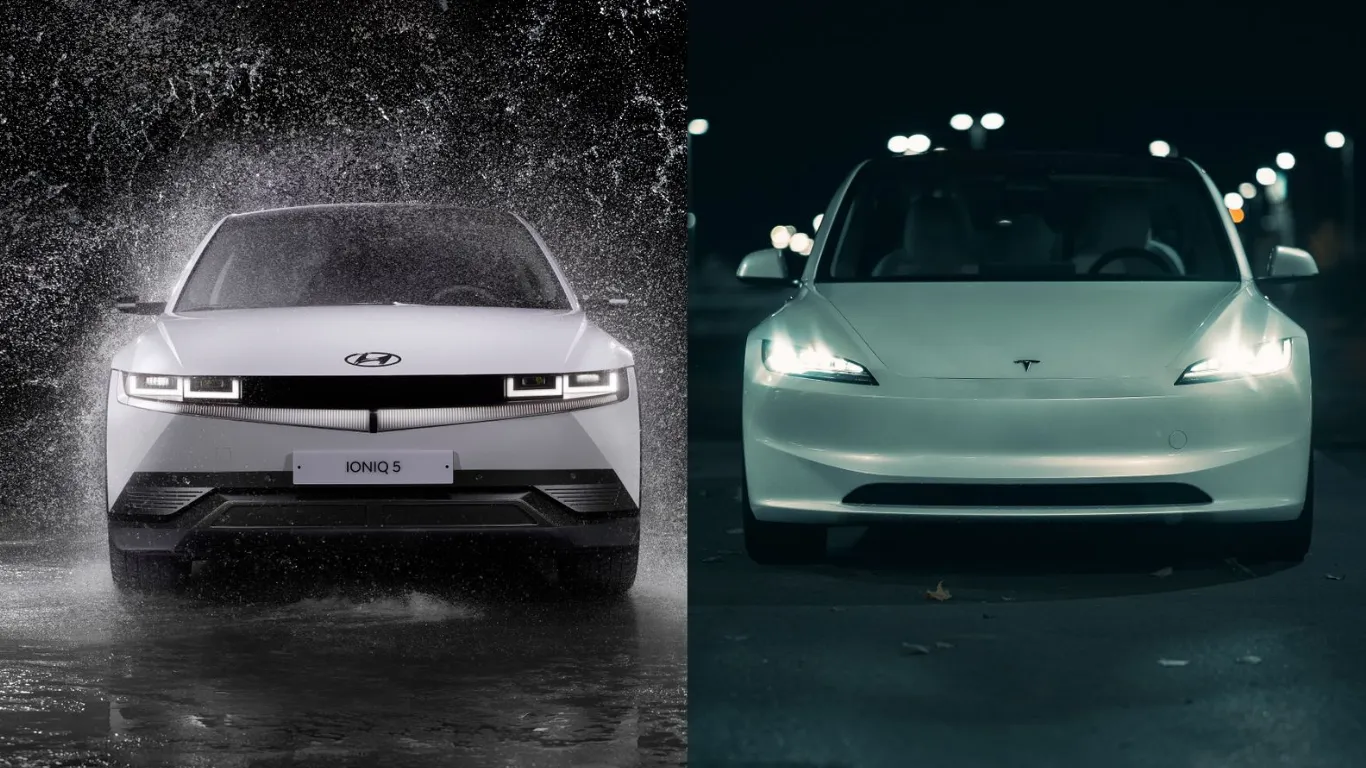
Evaluating the Hyundai Ioniq 5 vs Tesla Model Y 5 year cost requires looking far beyond the initial dealership sticker price. While the Hyundai Ioniq 5 often attracts budget-conscious electric SUV shoppers with a slightly lower starting MSRP, long-term financial data tells a very different story. Over a standard five-year ownership horizon, the Tesla Model Y typically delivers a lower total cost of ownership averaging around $46,000. In contrast, the Hyundai Ioniq 5 averages a five-year ownership cost exceeding $52,000, creating a financial gap of more than $6,000 in Tesla’s favor.
This surprising divergence stems primarily from Tesla’s superior resale value retention and significantly slower depreciation curves in the used electric vehicle market. Additionally, differences in comprehensive auto insurance premiums, regional electricity rates, and routine maintenance schedules subtly shift the annual financial burden between these two crossovers.
Prospective EV buyers who rely solely on monthly loan payments frequently overlook how rapidly depreciation erodes net automotive equity. By analyzing every line item—from initial tax incentives and charging efficiency to year-five trade-in values—smart car shoppers can protect their capital and choose the electric SUV that genuinely fits their long-term budget.
Breaking Down the 5 Year Cost of Ownership

A. Purchase Price and Upfront Incentives The Hyundai Ioniq 5 generally enters the showroom with a lower base MSRP than comparable long-range or all-wheel-drive trims of the Tesla Model Y. However, aggressive manufacturer price adjustments and federal point-of-sale tax credit eligibility often bring the Model Y’s effective out-the-door price right alongside or even below the Hyundai. Buyers must factor in destination charges, dealer markups on Hyundai lots, and Tesla’s direct-to-consumer order fees when establishing their baseline acquisition cost.
B. The Five-Year Total Cost Matrix To understand where the $6,000+ savings originate, it helps to examine every major expense category across 60 months of typical driving (15,000 miles per year). While operating costs like electricity and scheduled maintenance remain remarkably close, asset value retention acts as the decisive tiebreaker.
| Cost Category (5-Year Estimate) | Tesla Model Y (Long Range AWD) | Hyundai Ioniq 5 (SEL AWD) | Financial Advantage |
| Depreciation (Value Loss) | ~$24,500 | ~$30,200 | Tesla (+$5,700) |
| Auto Insurance Premiums | ~$10,800 | ~$11,400 | Tesla (+$600) |
| Electricity / Charging Costs | ~$3,400 | ~$3,650 | Tesla (+$250) |
| Maintenance & Repairs | ~$2,800 | ~$2,650 | Hyundai (+$150) |
| Taxes, Fees & Financing Interest | ~$4,500 | ~$4,400 | Hyundai (+$100) |
| Estimated 5-Year Total Cost | ~$46,000 | ~$52,300 | Tesla (~$6,300 Savings) |
Depreciation and Resale Value Trends
A. Year Three Value Retention Milestones During the first 36 months of ownership, electric vehicles experience their steepest market value adjustment as early adopters upgrade to newer battery architectures. By the end of year three, the Tesla Model Y typically retains roughly 62% to 65% of its original purchase price, translating to an approximate value loss of $17,000 to $18,500. Meanwhile, the Hyundai Ioniq 5 tends to retain around 53% to 56% of its initial value at the three-year mark, representing a steeper equity drop of roughly $21,500 to $23,000.
B. Year Five Resale Value Divergence By year five, the gap in used-market demand becomes even more pronounced due to Tesla’s dominant Supercharger ecosystem and continuous over-the-air software updates. A five-year-old Tesla Model Y generally holds onto 48% to 51% of its starting value, resulting in a cumulative five-year depreciation hit of roughly $24,500. Conversely, a five-year-old Hyundai Ioniq 5 typically retains closer to 38% to 41% of its original MSRP, leaving owners with approximately $30,200 in total depreciation losses.
C. Market Factors Driving Resale Demand Used EV buyers heavily prioritize seamless fast-charging reliability, battery thermal management longevity, and brand recognition in the secondary market. While Hyundai’s 800-volt ultra-fast charging architecture is technically impressive, Tesla’s widespread charging network and high-volume fleet familiarity keep secondary market resale prices noticeably firmer.
Insurance Maintenance and Charging Expenses
A. Direct Out-of-Pocket Operating Totals Setting depreciation and financing aside, direct out-of-pocket running expenses—covering insurance, electricity, tires, and routine servicing—total roughly $17,000 over five years for the Tesla Model Y and approximately $17,700 for the Hyundai Ioniq 5. Both vehicles eliminate expensive internal combustion maintenance items such as oil changes, spark plugs, timing belts, and exhaust repairs.
B. Auto Insurance Premium Variations Auto insurance represents the single largest out-of-pocket operating expense for both electric SUVs, averaging $2,160 annually for the Model Y and $2,280 annually for the Ioniq 5. Although Tesla vehicles previously suffered from high collision repair quotes, expanding third-party repair networks and Tesla’s in-house insurance offerings have stabilized its rates. Hyundai Ioniq 5 premiums remain slightly higher in several states due to expensive sensor arrays embedded in front and rear bumpers and longer wait times for specialized body panels.
C. Routine Maintenance and Tire Wear Over 60 months, scheduled maintenance and replacement tires cost roughly $2,800 for the Tesla Model Y compared to $2,650 for the Hyundai Ioniq 5. Both heavy crossovers accelerate tread wear due to instant electric torque, typically requiring a fresh set of EV-rated tires around the 30,000-to-35,000-mile mark. Hyundai edges out Tesla slightly on routine service bills thanks to accessible dealership service centers and straightforward cabin air filter and brake fluid intervals.
D. Home and Public Charging Costs Assuming 80% home Level 2 charging at national average residential electricity rates ($0.16 per kWh) and 20% public DC fast charging, the Model Y consumes roughly $3,400 in electricity over five years. Thanks to its slightly sleeker aerodynamic drag coefficient, the Model Y achieves superior highway efficiency compared to the boxier Ioniq 5, which averages around $3,650 in five-year energy expenses.
How to Maximize Your EV Investment
A. Audit Your Local Electricity Time-of-Use Rates Before signing a purchase contract, check whether your local utility provider offers discounted overnight EV charging tariffs. Shifting your Level 2 home charging schedule to off-peak midnight hours can cut your five-year electricity bill in half, saving over $1,500 regardless of which SUV you choose.
B. Verify Federal and State Tax Credit Eligibility Confirm current income caps, battery sourcing rules, and MSRP ceilings for federal clean vehicle tax credits alongside state-level rebates. Capturing a $7,500 point-of-sale tax credit immediately offsets first-year depreciation and dramatically lowers your monthly financing principal.
C. Obtain VIN-Specific Insurance Quotes Prior to Purchase Never assume two similarly priced electric crossovers will carry identical insurance premiums in your zip code. Request binding quotes using specific trim VINs for both the Ioniq 5 and Model Y to uncover regional underwriting differences before committing to a loan.
D. Factor Lease Incentives Against Cash or Loan Purchases Because commercial EV lease loopholes frequently allow manufacturers to pass through full tax incentives regardless of buyer income or assembly location, compare five-year total lease-to-buy numbers against traditional auto loans. Leasing can also insulate you from unexpected EV resale volatility if battery technology shifts rapidly over the next 36 months.
E. Prioritize High-Demand Trims and All-Wheel Drive If you plan to sell or trade in your electric SUV within five years, select popular configurations such as All-Wheel Drive and Long Range battery packs. Entry-level standard-range rear-wheel-drive trims often suffer steeper percentage depreciation penalties when competing in the secondary used market.
Conclusion

Comparing the five-year ownership finances of these two standout electric SUVs reveals why smart buyers look past the initial sticker price. While the Hyundai Ioniq 5 offers striking retro-futuristic styling and rapid 800-volt charging speeds, its steeper depreciation curve pushes five-year ownership costs past $52,000. The Tesla Model Y maintains a clear $6,000+ total cost advantage around $46,000, anchored by stronger resale demand and superior energy efficiency.
Out-of-pocket running expenses for insurance, tires, and electricity remain remarkably close at roughly $17,000 to $17,700 across sixty months for both models. Ultimately, locking in off-peak home charging rates, verifying tax credit eligibility, and comparing VIN specific insurance quotes will protect your automotive budget. Drivers prioritizing long-term equity retention and road-trip charging convenience will find stronger financial value in the Tesla Model Y.
Shoppers who secure aggressive lease incentives or dealership discounts on the Hyundai Ioniq 5 can narrow that cost gap while enjoying a refined, comfortable ride. Taking a disciplined, total-cost approach ensures your next electric SUV delivers both daily driving satisfaction and sound financial performance.

